Páginas

Mostrando entradas con la etiqueta Culture and traditions. Mostrar todas las entradas

sábado, 18 de marzo de 2017

Symbols and festivities

By Laura Sánchez

La senyera (Our Flag)

Catalan flag wich consists of four red stripes on a golden background. The same flag with a blue triangle and white star which could be seen arround nowadays represents Catalan independence.


L’ase Català (The Catalan donkey)

The ‘national’ symbol of Catalonia is a donkey opossed to the Spanish bull. It’s origins lie on a breed of donkey unique in Catalonia and Catalan speaking areas. The donkey emblem has many interpretations as to what it means. Some say it represents Catalans as hard working people whilst others say it is there to make fun of the Spanish bull.
  
The Correfocs, in which "devils" play with fire close to the onlookers, is one of the most striking of the Catalan festive events. The devils are not considered the incarnation of evil; they are festive characters, dancing to the sound of drums and the traditional "gralla" (a wind instrument), while they set off their fireworks.


Differential X’Mas traditions

In Catalonia, there are a few local Christmas traditions; 
one of them is the popular figure of the “Tió de Nadal” or “Tronquet”. 
The Tió means abundance: an old trunk in her womb gives dry sweets and sweets. 
 There is also the party “cagatió”,which name refers to make the Tió poo which is acompained with a traditional song.


Another custom is to put up a "Pessebre" Nativity scene, which often includes the “Caganer”, a figurine depicted in the act of defecation. 
Maybe in a future post I will tell you the story of this particular figurine.

Festivities
La diada de Catalunya
The Catalan "Diada" or National Day of Catalonia is on September 11, after the defeat and surrender of Barcelona to the French-Castilian army of Philip V of Spain and his supporters during the War of Spanish Succession. Similarly November 7 is also remembered in Northern Catalonia after the Treaty of the Pyrenees.
Currently, this tradition has become quite famous all over the world, because since 2010 a massive popular demonstration for claiming the independence of Catalonia has been organized. This and other Catalan or popular traditions are broadcasted by various prestigious communication medias from different countries.


Sant Jordi

Another tradition during the spring festival day of Sant Jordi (St George's Day). Catalonia’s answer to Valentine’s Day. Instead of 14th February, it is held on 23rd April, Sant Jordi is considerably more traditional. In which men give roses (mostly in a deep red color) to women, and women give a book to men as a present. That day is also known as "Dia del Llibre" (Book Day), coinciding with the anniversaries of the deaths of William Shakespeare, Miguel de Cervantes and Josep Pla, three world famous writers. The streets are full of people gathering around book and flower stands. Rumour has it that this is the day where Catalonia makes almost half of its total annual book sales!
  
Pyrenees Falles 
The Falles is a fire festival, that has been celebrated since the eleventh century. The festival is held before Saint John, when we light the famous “fogueres”.  

This event consists in bringing down fire torches from the mountains up to Saint John’s bonfires; this fire is brought by different participants called Fallers. They descent mountain with flaming torches, which go through different villages in the Pyrenees.  While the fire was brought down the views of the mountain are wonderful and people gather to watch the fallers bring down the fire.

The village receives the fire with music and a typical food. They give everyone coca and cava, they celebrate the light has come.  

The Falles was declared as Intangible Cultural Heritage of Humanity by Unesco. This recognition was received with great enthusiasm by people and now visitors from around Catalonia go there every summer.

La Patum
The Patum of Berga is a popular and traditional festival held in the city of Berga, the capital of the Berguedà, during the feast of Corpus Christi. This party represents that it is a struggle between Moors and Christians. It consists of various street performances and public participation, which is characteristic of the presence of fire and pyrotechnics.

The Patum of Berga is held once a year, the date of celebration varies due to coincide with the Christian festival of Corpus Christi, this makes the Patum is held between late May and late June. The main events of the festival take place during the week of Corpus, from Wednesday to Sunday. There are, however, some acts preliminary announcement of the holidays, which are the weeks preceding the feast of Corpus Christi.


lunes, 27 de febrero de 2017

"Raiers" or Timber rafters

By Mireia Vilaspasa


Timber rafting is an old log transportation method in which logs are tied together into rafts and drifted down the river the "Noguera Pallaresa". It is very similar to log driving.

Photo by Blanca Martinez-Ribes

This is an old tradition from the Catalan Pyrenees and the "Raiers Festival", celebrated in La Pobla de Segur, wants to commemorate this historical way of transport along the river: the rafts, or tied logs.

It has been celebrated since 1979, and its main activity is the rafts descent, on a Sunday morning.
The days before, the guys from the village have been assembling the rafts, following the age-old traditions. The longs are tied together and they are bound with ropes made of birch. They also build a rudder and a mast, that are useful to drive the engine and also to hang things: dry cloth, food, wine, etc.
There is not easy to ride a raft, because the river is abundant and with a lot of stones that can difficult the trip. 
On Sunday, there is a lot of expectation at the arrival, with neighbors and tourists who want to see the show: brave rafters dressed as old riders. The rafts start in Llania Dam, and after 6 kilometres, they arrive at Claverol Bridge.

miércoles, 22 de febrero de 2017

Sardana, a traditional street dance

By Anna Chalons

The sardana is another well-known Catalan tradition. The dance was originally from the Empordà region( in the north), but started gaining popularity throughout Catalonia during the 20th century.


Music for the sardana is played by a cobla, a band consisting of 10 wind instruments, double bass and a tamborí (little drum) played by 11 musicians. The cobla, this is the name the orchestra receives, has five woodwind instruments: the flabiol which is a small fipple flute, and the tenora and tible (two of each) which belong to the oboe family. You can see one in the video below. Competitions are organized all around the country especially during the spring and summer time. The "colles sardanistes" or teams dress up in their specific outfit as you can see in the video above.

In Catalonia, about one hundred and thirty cobles are active, most of which are amateur bands. Outside Catalonia, there is at least one more cobla: Cobla La Principal d'Amsterdam.
At any local celebration you will be able  to see people dancing in the main square of the town. It’s something very genuine and very deeply rooted in our culture. Some people may find it a bit cold as it is not as passionate as other Spanish dances or music like “flamenco dancing”.


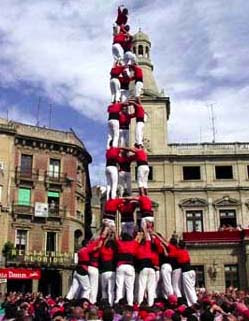
Castells or Human Towers

By Anna Chalons


In Catalonia there are many traditions which represent the spirit of Catalonia. Some of them refer to music, dancing, different kinds of food religions celebrations…
The best well known is “Els Castellers”. This is a human tower where  young and old, men and women participate.
Castelling began almost 200 years ago near Tarragona, just south of Barcelona. People form themselves into human towers with groups competing against each other in order to build   the highest and most elegant structures.
In Catalonia there are many “Colles Castelleres”, this is what the teams are called,  apart  from taking part in competitions they performance in their local celebrations.
Actually  "Castells"  are inscribed on Unesco's list of "intangible cultural heritage". 


Resultat d'imatges per a castellers imagenes


jueves, 12 de enero de 2017

Catalan cuisine

 Catalan cusine
by Maria José

Catalan pa amb tomàquet (bread with tomatoes). Image by Jo Cooke / Lonely Planet

Catalonia’s culinary  heritage  comes from Greek and Roman traditions. These two cultures are at the origin of the three key ingredient  in the Mediterranean  diet: olive oil, wheat and wine.

But Catalan cusine also owes to the Moors , who introduced new farming methods, as well as new products, such as rice, sugar and aubergines.

The evolution of Catalan cuisine  was also marked by the discovery of America and the introduction of such products like the tomato, which has been used in almost every dish ever since. Above all, tomatoes are the key ingredient in “sofregit”, a sauce containing a mixture of peppers, garlic, onions and tomatoes slowly simmered over a low flame, and which forms the basis of countless Catalan dishes.  Catalan cuisine has constantly absorbed influences that have helped to shape the country’s rich and diverse culinary traditions, in the region's culinary culture: sea and mountain;

The four culinary seasons

Autumn : Several mushroom types.

Winter : “Calçotada” (calçots are long, sweet onions that are grilled over red-hot embers);” xatonades” (xató is the traditional local salad, made from escarole, tuna and cod salad), rice dishes and casseroles, with white botifarra sausage and omelettes; as well as countless cod dishes.


Spring: strawberries  and cherries, These include the Snail Festival in Lleida and the fish casserole (suquet) season in Empordà county.

Summer : llonganissa dry-cured sausage, seafood platters (mariscada) at one of Catalonia’s fishing ports.

Tapas:

An original way of dining out, serve aperitifs and “vermouth”, an aromatic wine before lunch.

Catalan pa amb tomàquet (bread with tomatoes).:is the most simple dish  it serves  with ham , dried pork sausage or cheese..

The Catalan version of the pizza is the coca:

There are many variations, both savoury and sweet. The savoury option can come with tomato, onion, pepper and sometimes sardines. The sweet version, generally almond-based.

Traditional desserts:

Crema Catalana,  “ mel i mató” honey and fresh cream cheese, and “músic” – dried fruits and nuts served with a glass of sweet muscatel wine.

To know more bout it: